Wholesale software written on the floor of a wholesale dealership.
DealerStak was not designed for wholesalers and exporters by people who read a report about them. It was written by a Canadian wholesale operation that needed it, and every screen in it exists because somebody moving units asked why something took four steps. If you are measured on cost per unit and on how fast a car turns, this page is the short version.
- All-in landed cost on every unit
- Multi-vehicle Bills of Sale, signed electronically
- StakScore appraisals from a VIN
- Anonymous bid links
— Cost per unit
The deal you thought made four grand.
Every wholesaler has had this month. The board says the unit went out at a healthy gross, and then the transport invoice arrives, and the tire bill, and the safety, and the days it sat, and the deal quietly turns into something else entirely — three weeks after anyone could have done something about it.
It happens because the sale lives in one place and the costs live in five. DealerStak puts them on the unit as they happen, so the gross you are looking at is the gross after everything that already landed on the car.
That number is what you price the next one against. It is also what tells you which segments are actually paying you, ranked by units moved and average profit per unit, rather than by which deals felt good.
A wholesaler moving seventy-five units a month does not need a prettier report. They need the cost of a car to stop arriving late.
What lands on a unit
Purchase price
What you paid at the sale or off the street
Transport
Getting it to your lot
Reconditioning
Tires, glass, body, safety
Carrying cost
Floorplan interest and the days it has been sitting
Fees and admin
Everything else you attach to the unit
All-in landed cost
The only cost number worth pricing against. Subtract it from the sale and you have the gross that survives the month end.
Cost lines shown are illustrative. What actually lands on a unit is whatever your store logs against it, receipts included.
— Buy better, sell quieter
Two tools built for how wholesale actually trades.
One tells you what a unit is worth before you commit to it. The other lets you find out what the market will pay without telling the market whose car it is.
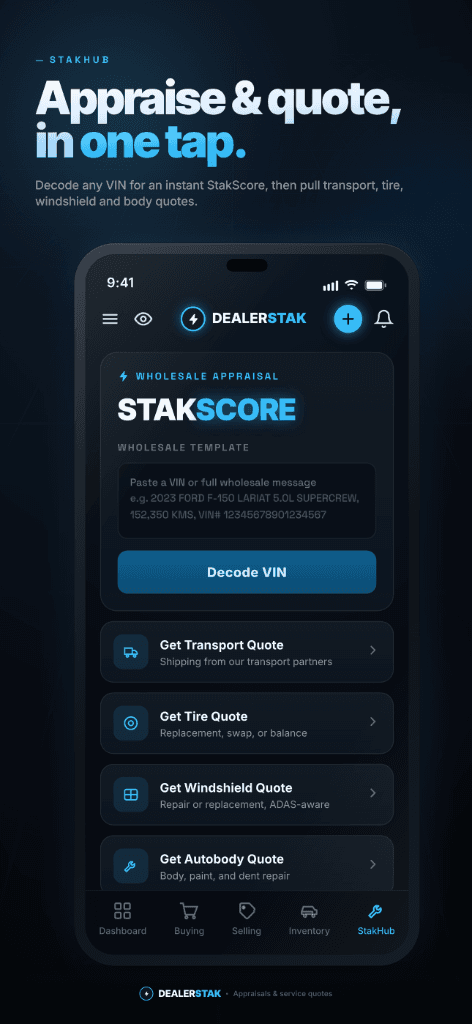
StakScore
What the unit is actually worth this week
Paste a VIN — or the whole messy wholesale message somebody sent you at 7am — and get a wholesale appraisal back, built from auction comparables rather than from a book value written last quarter.
- Decode from a VIN or from a pasted wholesale listing
- Priced against auction comparables, not a static guide
- Shareable by an expiring link when you need a second opinion
- Runs on the phone, standing beside the car
StakShare
Take bids without telling the market it is yours
Share a unit as a link and collect bids on it. Whoever opens the link sees the vehicle, not the store behind it — so you can test the market on a unit without the market drawing conclusions about your lot.
- A link you can send to anyone, no account required at their end
- Your dealership is not named on it
- Links expire, so an old share does not resurface next month
- Push straight to your phone when a bid comes in
— Paperwork
A four-unit deal should be one Bill of Sale.
Wholesale paperwork is its own animal: several vehicles on one deal, a buyer who is three provinces away, and a document that has to be right the first time because it is going into somebody else’s deal file as well as yours. The wholesale Bill of Sale is built for that, and it is a different document from the retail one.
One document, several vehicles
A four-unit deal is one Bill of Sale, not four of them stapled together and reconciled later. The totals are the deal's totals.
Signed electronically
Send a signing link and the other side signs from wherever they are. Stored signature specimens mean a repeat buyer is not re-signing from scratch every time.
Signing links that expire
A signing token has a life. An unfinished document from March cannot be signed in July by somebody who found the email again.
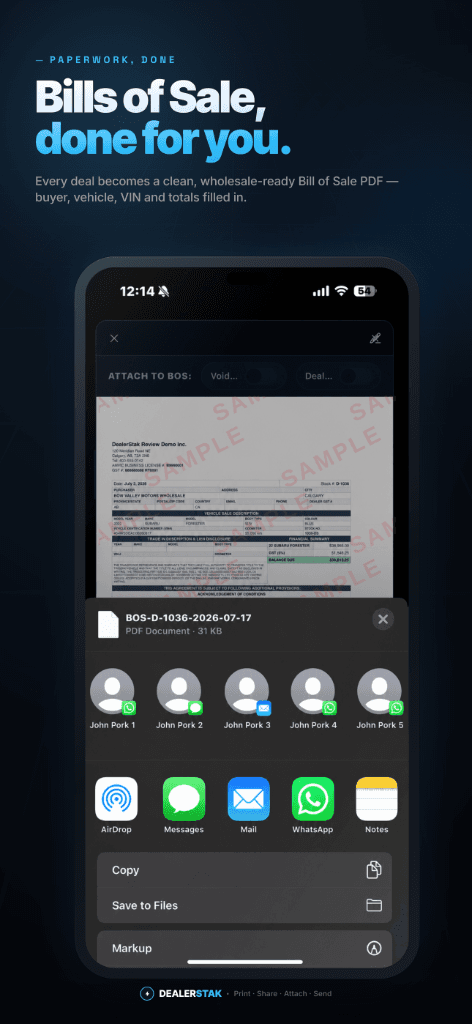
A real PDF, every time
Buyer, vehicle, VIN and totals filled in from the deal record — not a template somebody typed over and forgot to change a field in.
Scan the paper one you were handed
Photograph a Bill of Sale from the other dealership and it is read automatically. The buy gets logged in seconds instead of being re-keyed at the end of the week.
Watermarking
Drafts, samples and copies are marked as what they are, so an unsigned document cannot quietly circulate as a finished one.
Attachments combined
Bill of Sale, safety, lien search and whatever else belongs to the deal, sent as one file instead of six.
Stored encrypted, shared by short-lived link
Documents live in encrypted object storage and are served through signed links that expire. A forwarded URL does not become a permanent back door into your deal files.
— Know the unit
Decode it before you write the cheque.
A VIN and a phone is usually all you have when a unit is offered to you. That is enough here: the decode, the recall picture and the factory build sheet come back on the spot, and the unit is already half-created by the time you decide.
VIN decode, cached
Year, make, model, trim, body, drivetrain, engine and fuel from NHTSA plus a commercial data source. Over ten thousand VINs are already cached, so the common ones come back instantly.
Transport Canada recalls
Outstanding recalls on the unit, from the Canadian source rather than the American one — which matters when the vehicle is going to be registered here.
Window sticker lookup
Pull the original build sheet for Stellantis vehicles — Chrysler, Dodge, Jeep and RAM — so you are pricing the trim and options the truck actually left the factory with.
Units that are not yours
Consignment is handled as its own thing rather than pretending you own the car. The consignor is a record, the agreement is signed, and the unit carries its own paper trail from the day it arrives to the day it settles.
- Consignor records held against the unit
- Signed consignment agreements, stored with the file
- Tracked as consigned, not as stock you paid for
Retailing some of them too?
The same inventory feeds the marketplaces and your own website, and sold-unit retention follows the rule where you operate — fourteen days in Alberta, immediate removal in Ontario, Quebec and British Columbia. You do not have to remember which is which.
See the retail side— The books
The part you do on a Sunday.
In most wholesale operations the person reconciling the statement is the person who bought the cars. This is the part of the platform built to give that evening back.
Upload the statement, not the line items
Bank and credit-card statements are read automatically when you upload them. Nobody types four hundred rows in from a PDF.
Reconciliation with suggested matches
Receivables come back with match suggestions rather than a blank screen, so the work is confirming rather than hunting.
An accountant portal, not a shared login
Your bookkeeper gets scoped access to what they need without occupying a seat and without seeing the rest of the platform.
The executive view, exportable
The dashboard your accountant or your lender asks for, exported to a spreadsheet, without rebuilding it by hand every quarter.
— In your pocket
Most of this job happens standing in a compound.
The desk version of a dealer platform is no use when the unit is in front of you and the seller wants an answer. The iOS app is not a viewer — it scans the VIN, runs the appraisal, logs the buy and pushes the bid to your phone the moment it lands.
- Scan a VIN with the camera instead of typing seventeen characters in a snowstorm
- Push notifications the moment a bid comes in on a unit you shared
- Log the buy on the spot — snap the Bill of Sale you were handed and let it read itself
Updates arrive over the air, so the app on your phone is the version we shipped this week. Transport, tire and body quote requests are built into StakHub and switched on per dealer.
— Questions wholesalers ask
Straight answers, including the noes.
- What is StakScore?
- A wholesale appraisal you can run from a VIN or from a pasted wholesale listing. It prices the unit against auction comparables rather than against a book value published last quarter, and it works on the phone while you are standing beside the car.
- How does StakShare keep a bid request anonymous?
- You share a unit as a link. Whoever opens it sees the vehicle and can bid on it, but the link does not name your dealership — so you can test what a unit is worth across your network without the market working out whose lot is trying to move it. Links expire, so an old share cannot resurface months later.
- Do you integrate with Manheim, ADESA or EBlock?
- No. There is no auction platform integration and we would rather say so here than on a sales call. StakScore uses auction comparables for pricing, but you still buy where you buy — DealerStak is where the unit, its all-in cost and its paperwork live once you own it.
- Can one Bill of Sale cover several vehicles?
- Yes. A multi-vehicle deal is one document with the deal's totals on it, signed once, rather than four separate Bills of Sale to reconcile afterwards. It is generated as a proper PDF and can be signed electronically through an expiring signing link.
- Can my accountant get in without me paying for another seat?
- Yes. The external accountant portal gives a bookkeeper scoped access to what they need without occupying a user seat and without exposing the rest of the platform. Bank and credit-card statements can be uploaded and read automatically, and the executive dashboard exports to a spreadsheet.
- Do you handle consignment units?
- Yes. Consignment is supported with consignor records and signatures, so a unit you are selling on somebody else's behalf carries its own agreement and its own paper trail rather than being tracked as if you owned it outright.
— Where to go next
Wholesale is usually only half of it.
Plenty of wholesale operations retail a handful of units, or are about to start. It is the same platform, the same inventory and the same books — retail is just a switch you have not turned on.
Tell us how many units you move and we will talk in your numbers.
Volume, where you buy, where it goes and what your paperwork looks like today. We have run this operation ourselves, so the conversation starts further along than it does with a software company.
Start the conversationCanadian company, Alberta based, built by a working wholesale dealership. Your data stays yours and leaves with you.